Timeline
This section describes the development and use of the system as Collaboration needs evolve over the coming decade, culminating in physics datataking in the mid-2030s: from today's production campaigns and testbed exercises through calibration and CI, test beams, streaming and scaling challenges, commissioning, and early datataking to steady-state operations.
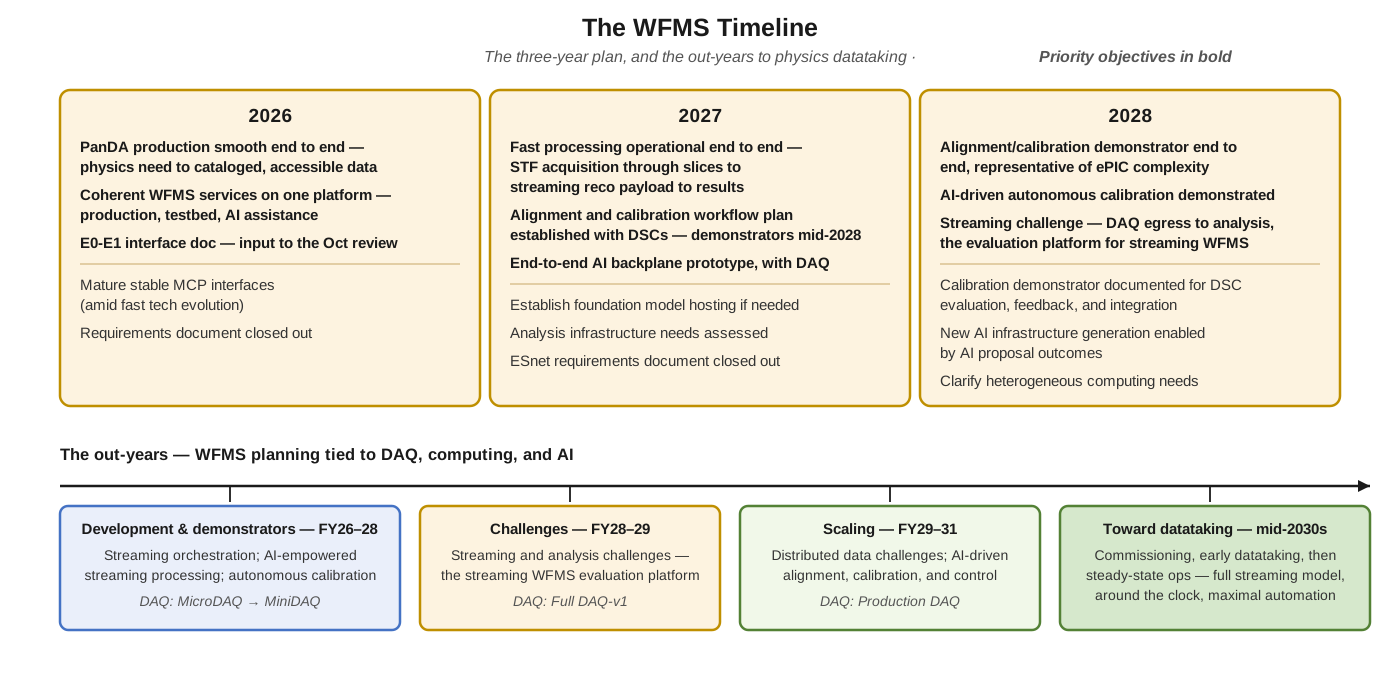
The out-years align with the joint planning of DAQ, computing, and AI:
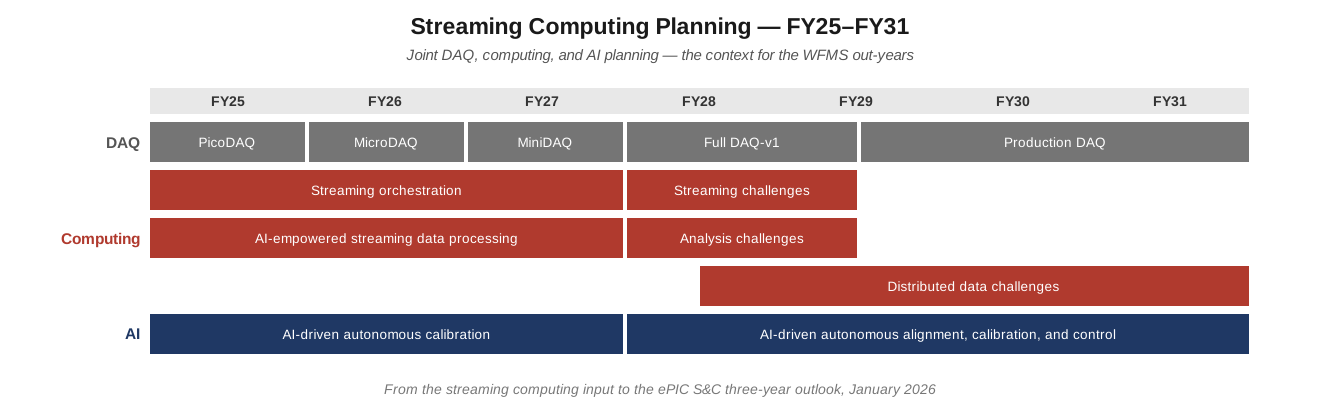
Three Year Activity Timeline
The near term is anchored in operating systems. Monthly production campaigns are moving to epicprod today. The campaign cadence is the delivery and validation rhythm for the production side of the WFMS. The automation buildout continues through this period: request ingest and requester notification, the validation loop with Hydra and AI assessment, deepening AI operations and reporting, and the steady conversion of operator procedures into automated ones with human control points.
The streaming workflow testbed advances from emulated E0-E1 workflows to progressively more realistic exercises: integration with DAQ developments as the streaming data formats and the exit-buffer interface firm up, scaled streaming exercises, and support for test beams, which serve as small-scale real-world testbeds for the developing DAQ and software. Calibration workflows, combining orchestration tools such as Snakemake with the platform, and distributed CI on PanDA-accessed resources come into use in the same window. E2 participation grows from the first integrations of institutional compute and storage toward defined facility roles.
Through this period the testbed's purpose is to inform: ePIC decision points on the streaming WFMS trajectory are taken on the evidence of these exercises.
The Longer High-Level Timeline
The long-range milestones follow the phases set out in the ePIC streaming computing model report1, which groups them by the CD process, the detector construction phase, and commissioning and operations, with priority always given to near-term needs so that development is continuously confronted with real-world exercise.
Through the detector construction phase, to about 2030, the WFMS is a principal system under test in the escalating series of collaboration exercises: streaming challenges exercising the streaming workflows from DAQ through offline reconstruction and the E0/E1 computing and connectivity; data challenges exercising scaling and capability as distributed ePIC resources reach substantial scale, including the functional roles of the Echelon tiers and E2 in particular; and analysis challenges exercising autonomous alignment and calibration and end-to-end workflows from simulated raw data through the analysis model. Throughout, the production system continues in routine operation, maturing the shared platform the challenges draw on.
Detector commissioning brings distinct requirements: semi-triggered datataking modes drawing as much detector performance information as possible, initial calibrations, the introduction of zero suppression, and the gradual extension of near-real-time processing from Echelon 1 to Echelon 2 — planned from the experience of the preceding challenges. Early datataking then adopts simpler, more conservative approaches while the streaming computing model is progressively deployed and validated against real beam data. Steady-state operation will mean the full streaming model in production, around-the-clock datataking, and the maximal-automation operations model carrying it with the small expert team ePIC will have.
-
The ePIC Streaming Computing Model. https://zenodo.org/records/14675920 ↩