Validation
This section documents WFMS support for ePIC validation, across produced data, streaming, sites and resources, and AI-based validation assessment.
Validation Scope
Validation in the WFMS spans the full latency range of the streaming computing model: detector and data evaluation within seconds on the fast streaming path, data-quality evaluation of prompt processing over minutes and hours, validation of produced campaign data over days, and the readiness decisions that gate campaign progress. It covers the data products themselves, the production and streaming workflows that make them, and the sites and resources they run on.
Science data product validation itself is not WFMS territory. The criteria, the evaluation, and the authority to sign off belong to ePIC validation and its experts and tools. The WFMS provides services to that effort: availability notification when data products are ready, produced-data references and access, execution of validation workloads on the platform, AI assessment machinery, and recording of validation outcomes against the production record.
WFMS Integrations with ePIC Validation
ePIC validation is anchored by Hydra, the ePIC validation application, which produces validation plots from data. The WFMS integrates with Hydra rather than duplicating it, through two interfaces now at the proposal stage (validation integration plan): an availability signal from epicprod to Hydra, and an assessment handoff from Hydra to the AI assessment application. The resulting loop runs from PanDA task completion, through an epicprod availability signal, to Hydra validation plots, to an AI assessment delivered as a natural-language judgment — recorded against the task or dataset it evaluates.
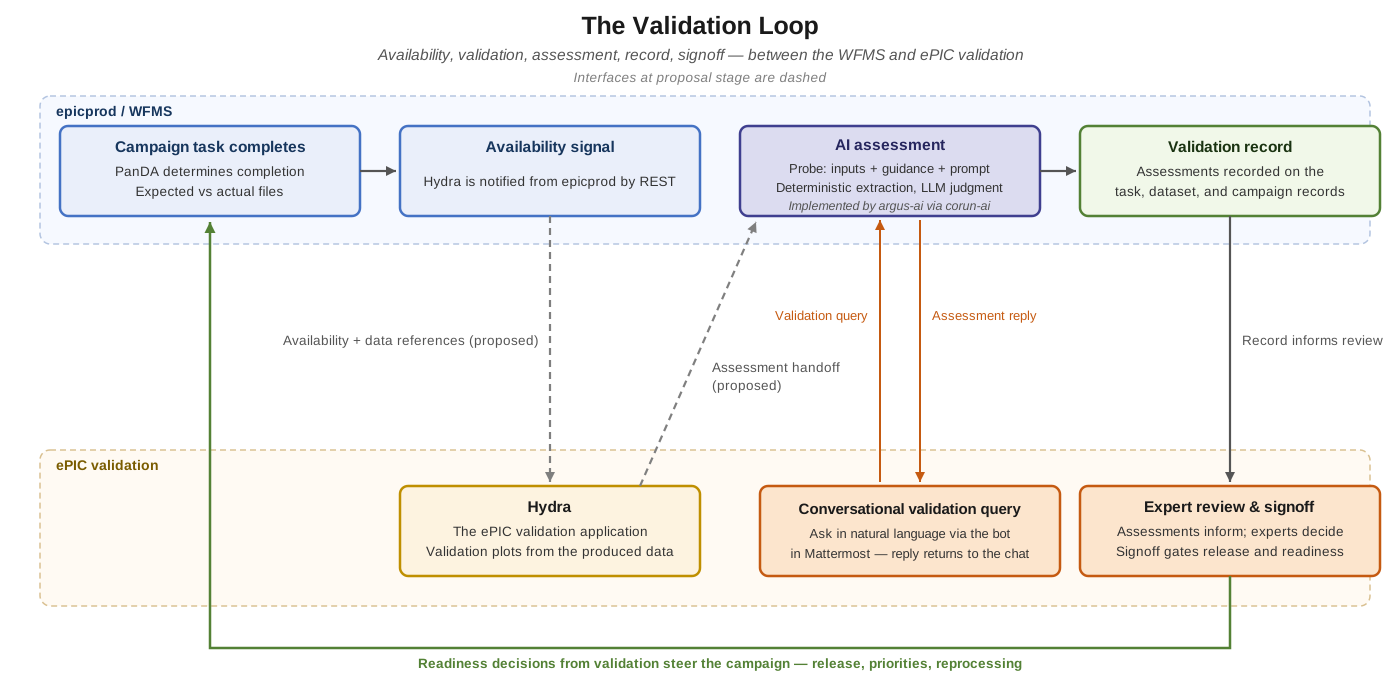
Availability is offered two ways, built on existing platform capabilities. A campaign-catalog JSON gives a comprehensive view of the current campaign — for each task or dataset its configuration tags, campaign, request, status, and produced Rucio references with file counts and completeness — which a consumer polls and diffs to find what is new and ready to validate. A live event delivers a per-unit notification the moment a unit becomes available, over the same SSE path that serves browser notification, including to external subscribers through the remote streaming proxy.
Campaign Readiness and Signoff
Validation feeds readiness decisions back into production. Validation experts evaluate produced data and their signoff gates what a campaign does next: whether a configuration is production-ready, whether produced samples are released for physics use, and whether issues found in validation redirect task priorities or trigger reprocessing. Task-level readiness checks in the prepping campaign are the front end of the same discipline: a task moves from draft to ready under checks, and its produced data moves to accepted under validation.
Validation state belongs on the catalog record. Outcomes, assessments, and signoff decisions are recorded against the task, dataset, and campaign they concern, so the production record carries its validation history alongside its configuration and its data products.
Data Product Validation
The unit of data product validation is the task/dataset — the unit that completes and can be validated. Completion is determined by PanDA, and epicprod signals availability as each unit completes, carrying completeness with it (expected against actual file counts) so a unit can be offered for validation once it reaches a chosen threshold. Hydra takes the availability information and the produced-data Rucio references and returns validation plots. The WFMS role is the signal and the record: announce what is ready, provide the references, and hold the outcome; the validation itself belongs to the validation application and experts.
Validation can also address groups: one evaluation can cover a request's set of produced datasets or a benchmark collection, independent of the per-unit availability signal.
Site and Resource Validation
The operational health of sites and resources is validated continuously through the platform's monitoring: queue and site state, error summaries by site and type, resource usage, and worker state, with the alarm system carrying conditions that need attention. Beyond passive monitoring, the same task machinery that runs production can run designated validation workloads against a site or queue — a controlled workload whose outcome qualifies the resource. Distributed CI, running ePIC software validation on PanDA-accessed resources, is the adjacent workflow domain built on the same capability.
AI-Based Validation Assessment
argus-ai, the assessment application of the corun-ai service (design note), provides AI assessment of validation targets, beginning with the physics monitoring plots in the Hydra validation browser. Its unit is the Probe: an expert-defined observation of a target, combining the inputs to fetch (plots and pages, JSON, text, with images read by a multimodal model), per-input guidance on how to read them, and the prompt that drives the assessment. Deterministic code does the extraction and normalization; the LLM supplies the judgment. A Probe is triggered from the web interface, by an inbound signal such as Hydra announcing an available validation, or conversationally through the production bot; whether a Probe runs automatically on an inbound signal is a per-Probe, per-source policy, keeping the assessment rate under operator control.
Each run becomes a new version of the Probe's assessment record, so a moving target accumulates an assessment history, and a run can reason over the current target, its reference or benchmark, and prior versions; "changed but acceptable" is a valid judgment. Completed assessments are delivered to every destination registered for the request — the web interface, the chat channel through the bot, and registered REST endpoints — with the requestor recorded. Like all AI outputs in the system, validation assessments carry provenance and are open to comment; they inform the human signoff decisions of ePIC validation rather than replacing them.